

If your cat hits the trails with you — or even just the backyard — ticks are one of the most important hazards prepare for. These tiny parasites lurk in the same wooded and grassy terrain adventure cats love to explore, and a single bite can transmit serious, sometimes life-threatening diseases.
The good news is that with the right prevention strategy, you can keep your feline hiking partner well protected. Here’s what every adventure cat owner needs to know about tick prevention for cats.
The dangers of ticks for cats
Ticks are blood-feeding parasites that latch onto a host, feed for days, and can transmit a range of pathogens in the process. More than 800 species of ticks have been identified worldwide, but only a dozen or so are associated with significant feline disease.
The tick-borne illnesses most relevant to cats in the United States include:
- Cytauxzoonosis (Bobcat Fever) This is arguably the most alarming tick-borne disease for domestic cats in the U.S. because it’s often fatal. It’s transmitted primarily by the lone star tick, and infected cats typically develop high fever, lethargy, difficulty breathing, and anemia. While the parasite is relatively harmless in bobcats — the natural reservoir host — domestic cats have little natural resistance to it. Most cases of cytauxzoonosis in the U.S. occur in the southeastern and south-central states between March and September when the arachnids are most active.
- Lyme Disease This bacterium is transmitted through black-legged tick (deer tick) bites, and infection in cats is rare because felines are highly resistant to it. If infection does occur, cats can show symptoms such as lethargy, fever, loss of appetite, and fatigue.
- Anaplasmosis and Ehrlichiosis These bacterial infections, transmitted by black-legged and lone star ticks respectively, can cause fever, lethargy, loss of appetite, and in some cases more serious systemic illness. While these infections have been documented in cats, both anaplasmosis and ehrlichiosis are very rare illnesses in felines.
- Tularemia Also known as “rabbit fever,” tularemia is a bacterial infection that cats can contract through tick bites — as well as by hunting infected prey. Fortunately, it’s an uncommon infection in cats.
In addition to disease transmission, ticks can also cause skin irritation and secondary infections.
Keep in mind that there’s no vaccine available to protect cats from tick-borne diseases, so prevention is the only reliable line of defense.
Where are ticks the biggest threat?
Ticks are found worldwide, but risk level varies significantly by region; however, risk is rising almost everywhere because of global warming. According to the CDC’s tick distribution data, in the U.S., major tick species and their primary geographic ranges are:
- Black-legged tick (deer tick): It’s widely distributed across the eastern United States, with the highest concentrations in the Northeast, upper Midwest, and Mid-Atlantic states. This is the primary area for Lyme disease and anaplasmosis.
- Lone star tick: It’s widely distributed across the South, Southeast, and increasingly the Northeast and Midwest. This tick is the primary vector for cytauxzoonosis in cats.
- Western black-legged tick: This tick is found along the Pacific Coast, particularly in northern California, and capable of transmitting Lyme disease and anaplasmosis.
- Rocky Mountain wood tick: It’s found in the Rocky Mountain states at elevations between 4,000 and 10,500 feet.
- American dog tick: This tick is distributed broadly east of the Rockies, and a known vector of Rocky Mountain spotted fever and tularemia. Despite its name, it can infect cats.
- Asian long-horned tick: This is an invasive species now established across more than 20 states in the eastern U.S. as of 2024, with its range expanding.
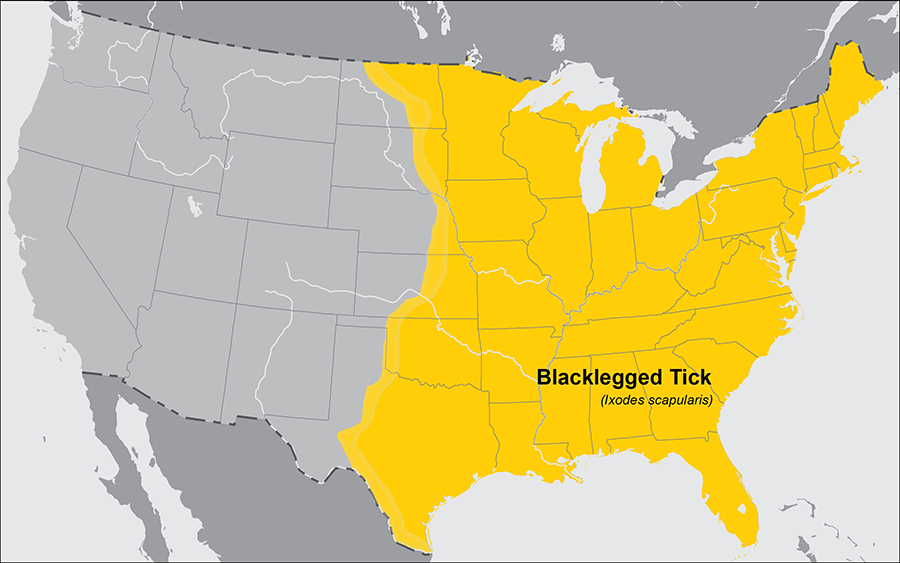
The highest-risk tick scenarios for adventure cats involve hiking or camping in wooded, brushy, or tall-grass areas anywhere in the East, South, or Midwest — though no region is entirely tick-free. Ticks are most active in spring and summer, but remain a threat any time temperatures are above freezing.
How to protect your cat from ticks
Tick prevention for hiking cats requires a layered approach. No single method is foolproof, so combining strategies gives your cat the best protection.
1. Use a veterinarian-approved tick preventive.
Talk to your vet about a prescription or vet-recommended tick prevention product formulated specifically for cats before your next outing.
Never use dog tick preventives on cats — many contain permethrin, which is highly toxic to felines.
Year-round tick prevention for cat is often recommended since ticks can be active in many environments and climates.
2. Stick to the trail.
Ticks don’t jump or fly — they wait on grass blades, brush, and leaf litter and grab onto passing hosts in a behavior called “questing.”
Keeping your cat on a leash and on established trails reduces the chance of brushing against tick-heavy vegetation. Avoid letting your cat wade through tall grass, explore dense brush, or roll in leaf piles during tick season.
3. Do a thorough tick check after every outing.
Check your cat carefully from nose to tail after every adventure. Ticks favor warm, hidden areas: around the ears, under the collar, between the toes, in skin folds, and along the belly and groin.
The sooner a tick is found and removed, the lower the risk of disease transmission — most pathogens require the tick to be attached for at least 24 hours before transmission occurs.
For a detailed guide to checking your cat for ticks and safely removing them, see our article How to Check Your Cat for Fleas and Ticks.

4. Treat your gear, too.
Permethrin-treated clothing and gear can significantly reduce tick exposure for you on the trail — and fewer ticks on you means fewer opportunities for one to transfer to your cat. Just be certain that permethrin-treated items are completely dry before your cat comes into contact with them, as wet permethrin can be harmful to cats.
Never apply permethrin sprays directly to your cat or to gear your cat will directly contact while still wet.
A note on ‘natural’ tick prevention for cats
Many cat owners search for natural tick prevention for cats, hoping to avoid chemical treatments.
And essential oils — including tea tree, eucalyptus, peppermint, pennyroyal, and cinnamon oil — are frequently marketed as natural tick repellents. However, essential oils — even if they’re labeled as safe for pets — can be toxic to cats.
Unlike dogs and humans, cats lack certain liver enzymes needed to metabolize many essential oil compounds, meaning even small amounts can accumulate and cause harm.
The safest “natural” approach for tick prevention in cats is environmental: Minimize tick habitat exposure, conduct thorough post-hike checks, and consult your vet about the lowest-intervention pharmaceutical option.
Tick prevention products for cats
Always consult your veterinarian before starting any tick prevention regimen, as the right product depends on your cat’s age, weight, health status, and the specific tick species in your region.
That said, here are the most commonly recommended options:
Topical spot-on treatments
Topical treatments are the most widely used form of tick prevention for cats and are generally preferred over oral options because getting cats to take pills can be difficult. These treatments are applied to the cat’s skin at the back of the neck or between the shoulder blades, where cats can’t easily lick them off.
- Bravecto Topical for Cats: A topical solution containing fluralaner that provides 12 weeks of protection against black-legged ticks and Asian longhorned ticks. Bravecto Plus adds coverage for heartworm, roundworms, and hookworms with an 8-week application cycle. This treatment is approved for cats 6 months and older that weight at least 2.6 pounds.
- Revolution: A monthly topical that protects against fleas, ticks, ear mites, and heartworms. It’s safe for kittens as young as 8 weeks old, making it a versatile option for multi-cat households.
- Frontline Plus: A monthly topical effective against ticks, fleas, and their eggs and larvae. It’s approved for cats over 8 weeks old that weight at least 1.5 pounds.
Flea and tick collars
- Seresto Collar — This is one of the most recommended collar options among veterinarians, and it releases a continuous low concentration of imidacloprid and flumethrin, providing up to eight months of flea and tick protection. It’s odorless, non-greasy, and safe for kittens 10 weeks and older.
What to avoid
- Never use dog tick products on cats.
- Don’t apply essential oils to cats.
- Don’t use any tick-prevention treatment on your cat without consulting a veterinarian.
The bottom line for tick prevention in cats
Ticks are a genuine hazard for any cat who ventures outdoors, and the risks are growing as tick populations expand across the world.
But with a consistent tick prevention protocol — starting with a conversation with your vet, a vet-approved preventive product, and thorough post-hike checks — you can keep your adventure cat safe on the trail.
The best tick prevention for cats combines parasite control products with smart outdoor habits — and the peace of mind that comes with being prepared is well worth the effort!