

If you’ve ever wished you could bring your cat along on a hike, a trip to the farmers market, or even just a walk around the neighborhood, a cat backpack might be exactly what you’ve been looking for.
These purpose-built carriers have exploded in popularity among the adventure cat community — and for good reason.
But tossing your cat inside a backpack on day one and hitting the trail is a recipe for a stressed-out kitty and a very bad time.
The secret to a backpack-loving cat is a gradual, positive introduction that lets your feline friend set the pace.
This guide walks you through the entire process of how to backpack train your cat from choosing the right gear to taking your first real-world adventure together.
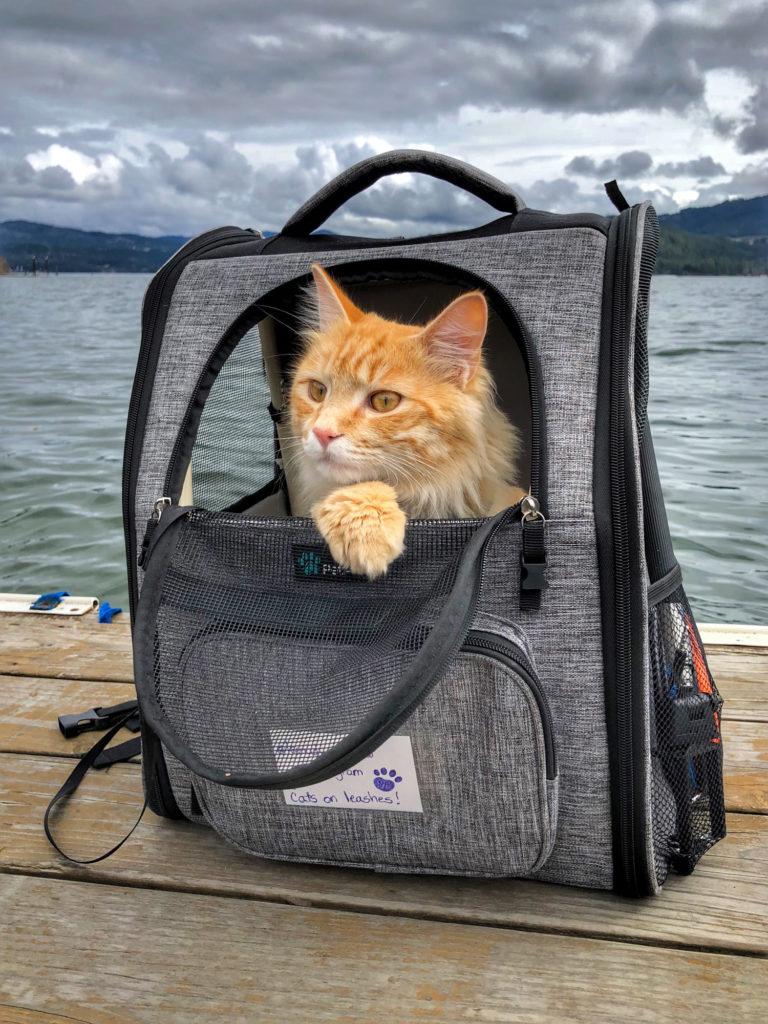
Why use a cat backpack?
Before diving into the training process, it helps to understand why a cat backpack might be a good option for you and your cat.
Safe outdoor enrichment
Indoor cats are protected from the hazards of free-roaming outdoor life, but that protection comes at a cost: boredom, understimulation, and the behavioral issues that follow. The outdoors is rich with new sights, sounds, and smells that engage a cat’s senses in ways no indoor environment can fully replicate. A cat backpack gives your cat supervised access to that world without the risks of letting them free roam.
Mental and physical health benefits
Environmental enrichment is widely recognized by veterinary behaviorists as essential to feline well-being. Regular exposure to novel environments helps keep a cat’s brain active, reduces anxiety, and can even curb destructive behaviors that stem from boredom. A cat backpack can make that enrichment more accessible — and portable.
Hands-free convenience
Unlike a cat stroller or a handheld carrier, a backpack keeps your hands free, which can be important when you’re navigating a trail, managing a leash, or simply getting through a busy city street. It also keeps your cat at shoulder height, which many cats find less stressful than ground level — it’s why it’s so important to have vertical space in your home.
Easier vet visits and travel
A cat that’s comfortable in their backpack is a cat that’s easier to transport. Whether you’re heading to the vet or a weekend camping trip, a well-trained cat will settle into their backpack calmly rather than turning every trip into a battle.
Bonding
Shared adventures strengthen the bond between cat and human. There’s something genuinely special about watching your cat survey a mountain view from your shoulders or sniff the breeze on a lakeside trail, and cat backpack training creates the foundation for those ameowzing experiences.
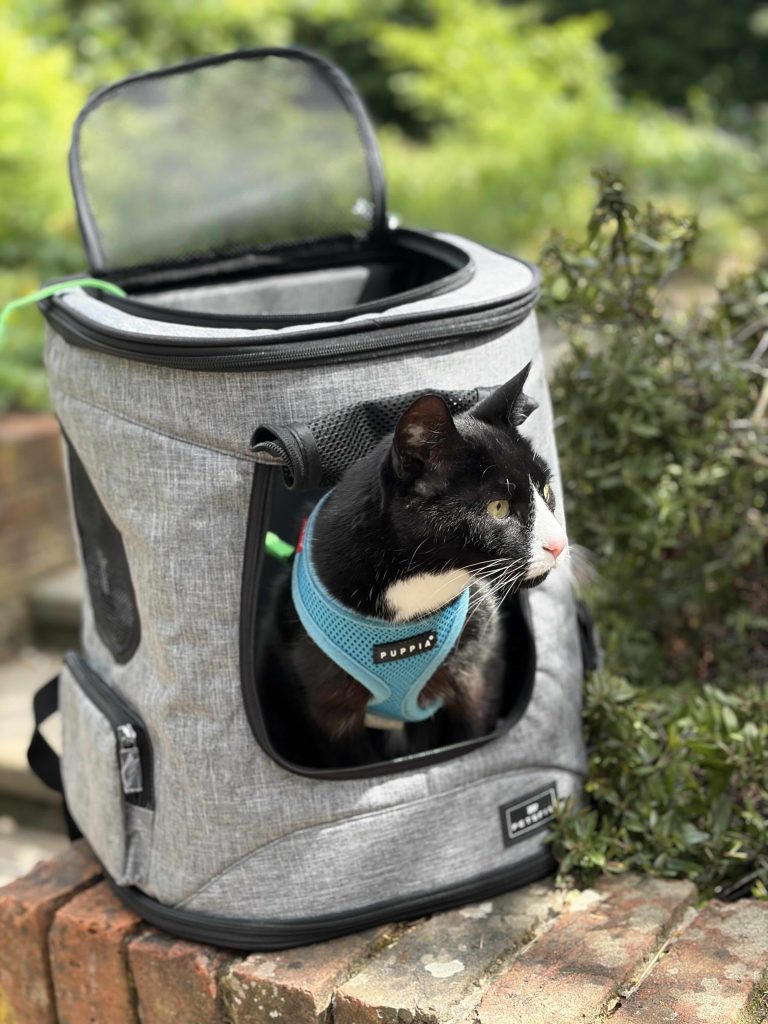
What to look for in a cat backpack
Before you can train your cat, you need the right gear. Not all cat backpacks are created equal, and the wrong one can undermine your training before it even begins.
- Ventilation: This is non-negotiable. Overheating is the most common safety concern with cat backpacks, so look for multiple ventilation panels, such as full-length mesh sides, ventilation holes, and (if you choose a bubble-window model) airflow built into the capsule itself. Cats in poorly ventilated carriers can begin showing signs of heat stress after just a few minutes of walking in mild weather.
- Size: Your cat needs enough room to stand up, turn around, and lie down comfortably. Most cat backpack manufacturers publish weight limits, which you can use as a starting point, but also consider your cat’s body length.
- Security: The backpack with an internal safety tether that clips to your cat’s harness — not their collar.
- Comfort: A padded, removable mat on the floor of the backpack makes a big difference, especially on longer outings.
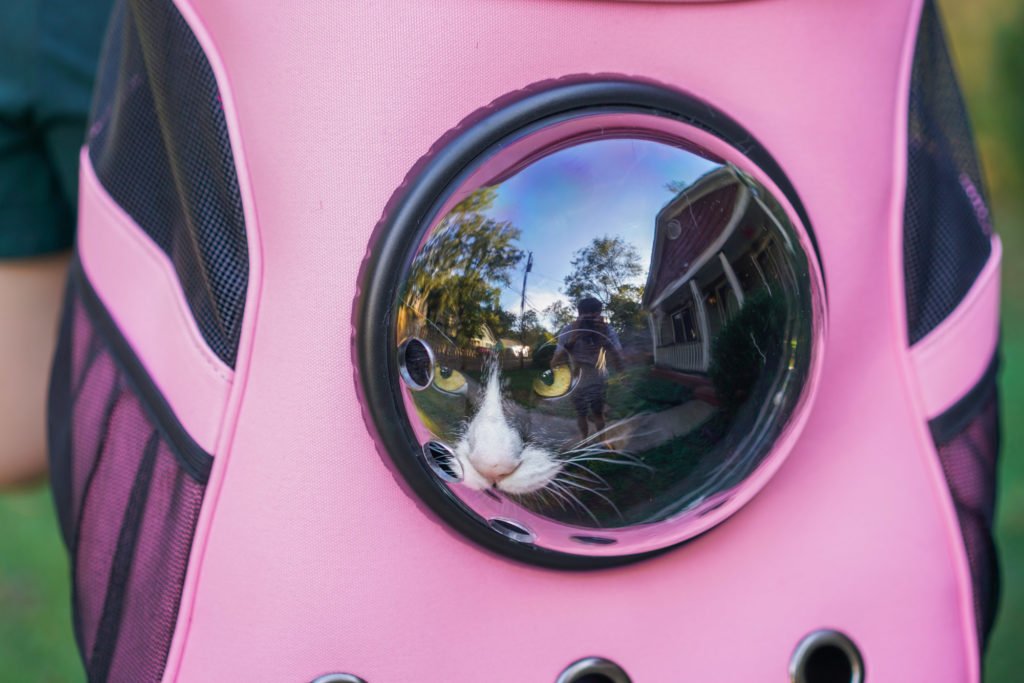
A note about bubble-window backpacks: Soft-sided backpacks generally offer better airflow and temperature regulation. Bubble-window backpacks are popular and do lead to some adorable photos, but they can trap heat in direct sunlight. If you go the bubble route, confirm it has active ventilation built in.
How to backpack train your cat: A step-by-step guide
Some cats may be instantly comfortable in a backpack.
My cat Siri, for example, took an instant liking to his backpack and jumped right in and was ready to go. However, this wasn’t the case with his first backpack, which he never got comfortable in. Cats have preferences just like we do!
Often though, cat backpack training isn’t a one-session project. It’s a gradual desensitization process built on positive associations (aka “pawsitive reinforcement).. Expect it to take anywhere from one to several weeks depending on your cat’s temperament. Rushing the process is the single most common mistake people make — and it can set you back significantly.
The method below uses positive reinforcement, which means your cat is never forced or coerced. They learn at their own pace, and every step forward is rewarded.
Step 1: Introduce the backpack.
Set the backpack open in a room your cat frequents and simply leave it there. Don’t try to put your cat inside. Don’t make a fuss. Let your cat investigate on their own terms.
Cats are curious, and many will sniff the backpack, walk around it, and eventually climb inside within a day or two. Every time you catch your cat near or inside the backpack, mark the behavior (with a clicker or a verbal “yes!”) and reward with a treat.
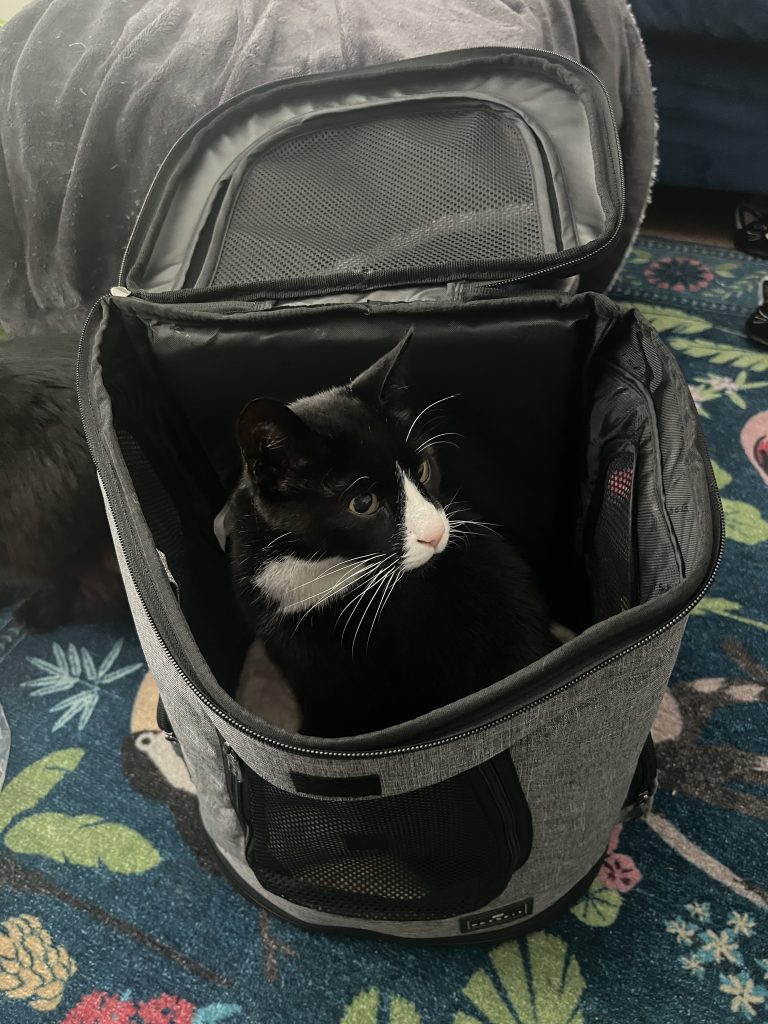
Step 2: Build a positive association with the backpack.
To make the backpack more inviting, you can place your cat’s favorite blanket inside so there’s a familiar scent. You can also leave treats, toys, catnip or silvervine inside — they’ll start checking the backpack regularly on the off-chance something good has appeared.
The goal is for the backpack to become one of your cat’s favorite places in the house — not one they’re forced into. Never lure your cat inside and then immediately zip the backpack closed. That’s a surefire way to create a negative association.
Step 3: Practice closing the backpack for short periods.
Once your cat is comfortable hanging out inside the open backpack, start closing it briefly while they’re inside and there’s a treat waiting for them. Start with just a few seconds, reward, and open it again. Gradually increase the closed time over multiple sessions.
Watch your cat’s body language closely. A relaxed cat will look curious, lie down, or sniff around. A stressed cat will pant, vocalize, scratch at the sides of the backpack, or try to back out
If you see stress signals, let your cat out and back up a step.
Step 4: Lift and carry the backpack.
With your cat inside and settled, gently pick up the backpack and take a few steps. Set it back down, open it, and reward.
This is often where cats who tolerated the backpack stationary suddenly realize things are different — motion changes the experience entirely.
Build up slowly: Take a few steps, then do a lap around the room, then a walk down the hallway, etc. Each session should end before your cat shows signs of stress.
Step 5: Wear the backpack.
Once your cat is comfortable being carried, put the backpack on your back as you normally would. Start with just a minute or two, reward when you take it off, and gradually extend the duration.
It can be helpful to practice this step with someone to help you lift the backpack onto your back to make the experience less jarring for your cat.
To help desensitize your cat to the motion, try a few things: pick up the backpack, sway gently, reward. Walk faster, then slower. The more varied the movement your cat experiences at home, the more adaptable they’ll be in the real world.
Step 6: Take short trips outdoors.
Your first outdoor trip should be short, calm, and low-stimulation. The backyard, a quiet street or a calm park path is ideal — not a busy trailhead. Aim for five to ten minutes. Keep your own energy calm and reassuring. After returning home, provide a generous treat reward of play with a favorite toy.
Build up gradually from there: longer walks, new environments, more stimulating settings. Let your cat’s comfort level guide the pace.
Step 7: Introduce car travel.
If your adventures will involve driving to a trailhead, introduce car travel separately.
Start the car without going anywhere while your cat is in the backpack and reward calm behavior. Back out of the driveway and return. Build up to short loops before graduating to longer drives.
Secure the backpack on the seat — belted in — rather than the floor for better airflow and stability.
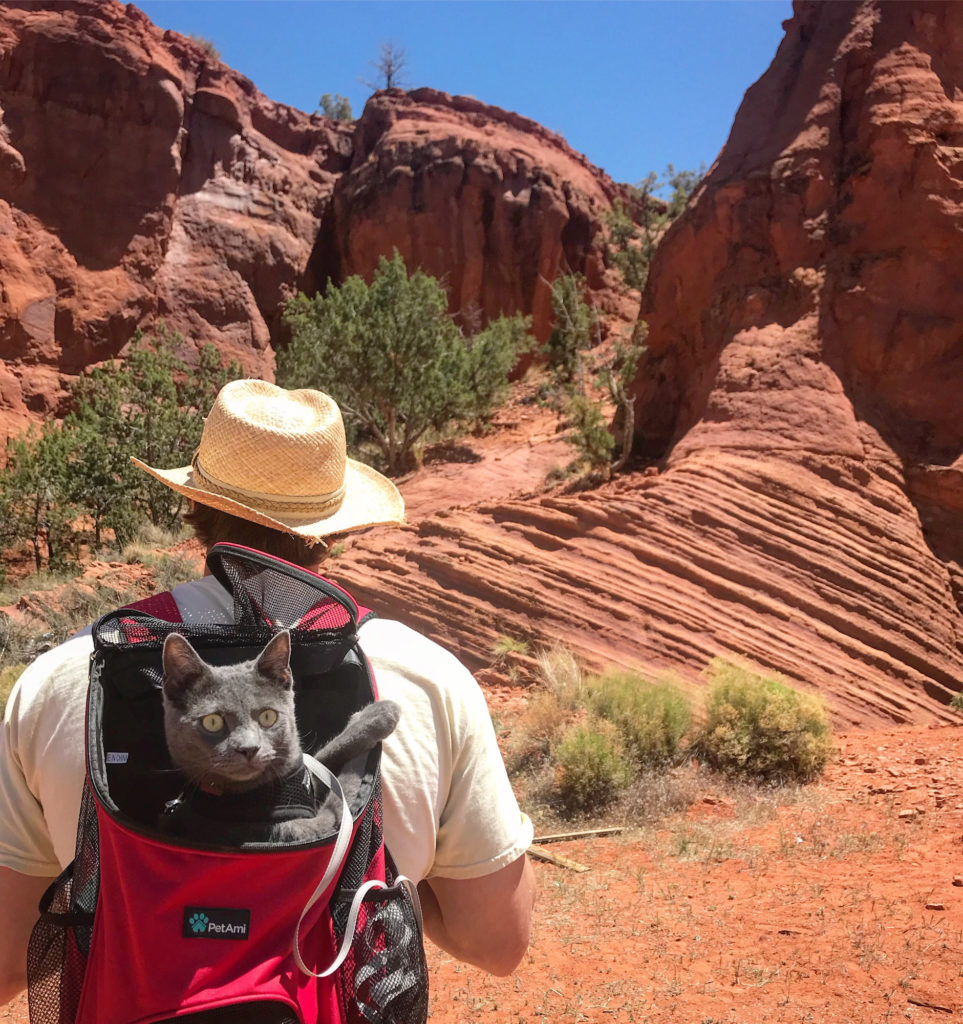
Cat backpack safety: What you need to know
No amount of cute Instagram photos changes the fact that a backpack is a confined space, and safety requires active attention.
Watch for signs of overheating.
Overheating is the primary risk with any enclosed cat carrier. A cat’s normal body temperature is 101–102.5 degrees Fahrenheit (38-39 degrees Celsius), and interior temperatures in a confined space can climb quickly, especially in direct sunlight.
Cats begin experiencing heat stress when interior carrier temperatures exceed 85 degrees Fahrenheit, according to the Journal of Feline Medicine and Surgery, and heatstroke can be fatal.
Signs of overheating:
- Excessive panting
- Drooling
- Restlessness
- Lethargy
- Bright red gums.
If you observe any of these, remove your cat from the backpack immediately, move to a cool area, and offer water. In severe cases, this is a veterinary emergency.
A few tips:
- Avoid using a backpack on hot or humid days
- Never leave a cat in a backpack in direct sunlight
- Keep in mind that very young and very old cats are more at risk of overheating, as are flat-faced cats, such as Persians.
- On warm days, limit trips to 45 minutes or less
- Choose a backpack with full mesh ventilation panels
Watch for signs of stress.
Overheating isn’t the only risk. Psychological stress from an unfamiliar environment can be just as harmful.
Signs your cat is stressed include: excessive vocalization, frantic attempts to escape, elimination inside the carrier, or aggression when approaching the backpack.
Some cats simply aren’t good candidates for backpack travel — particularly cats with severe anxiety, respiratory conditions, or heart issues. If your cat shows persistent, worsening stress despite proper desensitization, your cat may simply prefer not adventure in a backpack.
Always use a harness and safety tether.
Use an internal tether clipped to a well-fitted harness — never a collar — whenever your cat is in the backpack. If the zipper is accidentally opened or your cat manages to escape, the tether prevents them from bolting. This is especially important on trails or in unfamiliar areas.
Limit duration.
Even a well-acclimated cat has a comfort ceiling. Most cats tolerate trips of one to two hours comfortably. Beyond that, hydration, bathroom needs, and stress accumulation become factors. On longer outings, plan rest stops where your cat can come out on their harness and leash for a break.
Keep in mind that not every cat is a good candidate.
Not every cat will take to backpack training, and that’s okay. Respect your individual cat’s limits. A cat who shows persistent distress is telling you something important — listen to them.
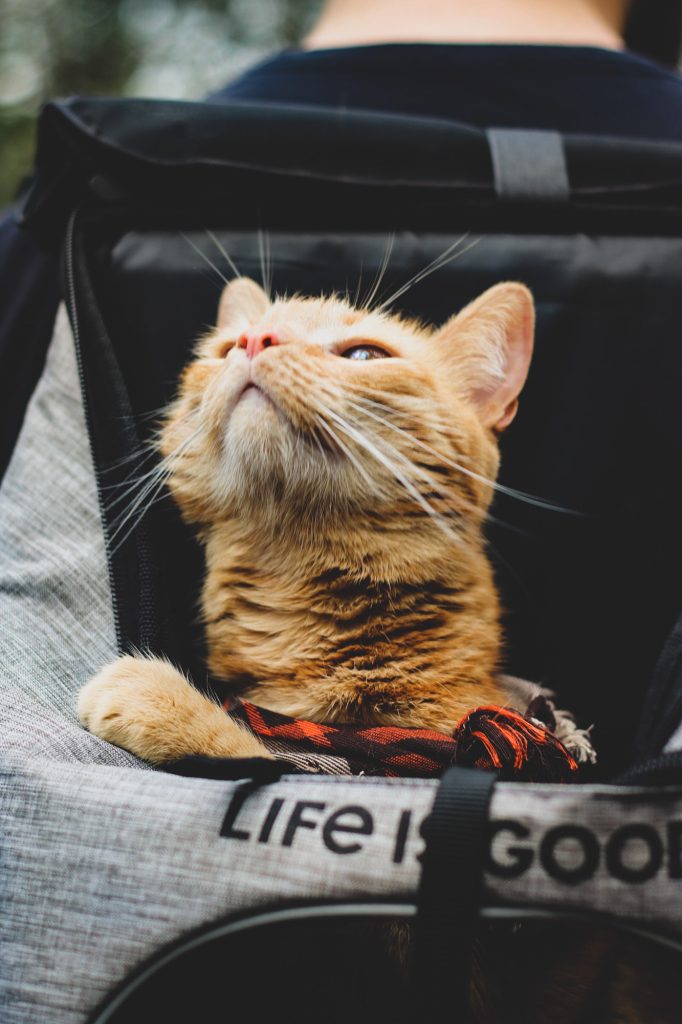
Cat backpack do’s and don’ts
Here’s a quick roundup of tips and tricks to make your backpack adventures both fun and safe.
Do’s
- Do introduce the backpack slowly, leaving it out for your cat to explore at their own pace before any training begins.
- Do use high-value treats reserved exclusively for backpack training to build strong positive associations.
- Do watch your cat’s body language throughout every session and back up a step if you see stress signals.
- Do use a properly fitted harness and internal safety tether every time your cat is in the backpack.
- Do choose a backpack with adequate ventilation — this means multiple mesh panels, not just a single window.
- Do keep early outdoor trips short and gradually increase duration as your cat’s confidence grows.
- Do bring water or hydrating treats on any outing longer than 30 minutes and offer it at rest stops.
- Do end every training session on a positive note — stop before your cat is stressed, not after.
Don’ts
- Don’t force your cat into the backpack. Forcing a cat into any carrier is a fast way to permanently associate it with fear and struggle, and both of you could end up injured.
- Don’t rush the process. Each cat moves at their own pace.
- Don’t use the backpack in extreme heat or leave it in direct sunlight. Heat buildup can become dangerous quickly.
- Don’t clip the internal tether to your cat’s collar — always use a harness.
- Don’t use a regular hiking backpack as a substitute for a purpose-built cat backpack. Standard backpacks lack ventilation, structural support, and safety features.
- Don’t ignore signs of distress. Panting, excessive vocalization, and frantic escape attempts are not behaviors to push through — they’re signals to stop.
- Don’t take your cat to busy, high-stimulation environments before they’re comfortable in quiet ones.
- Don’t assume all cats will adapt. Some cats genuinely don’t enjoy backpack travel.
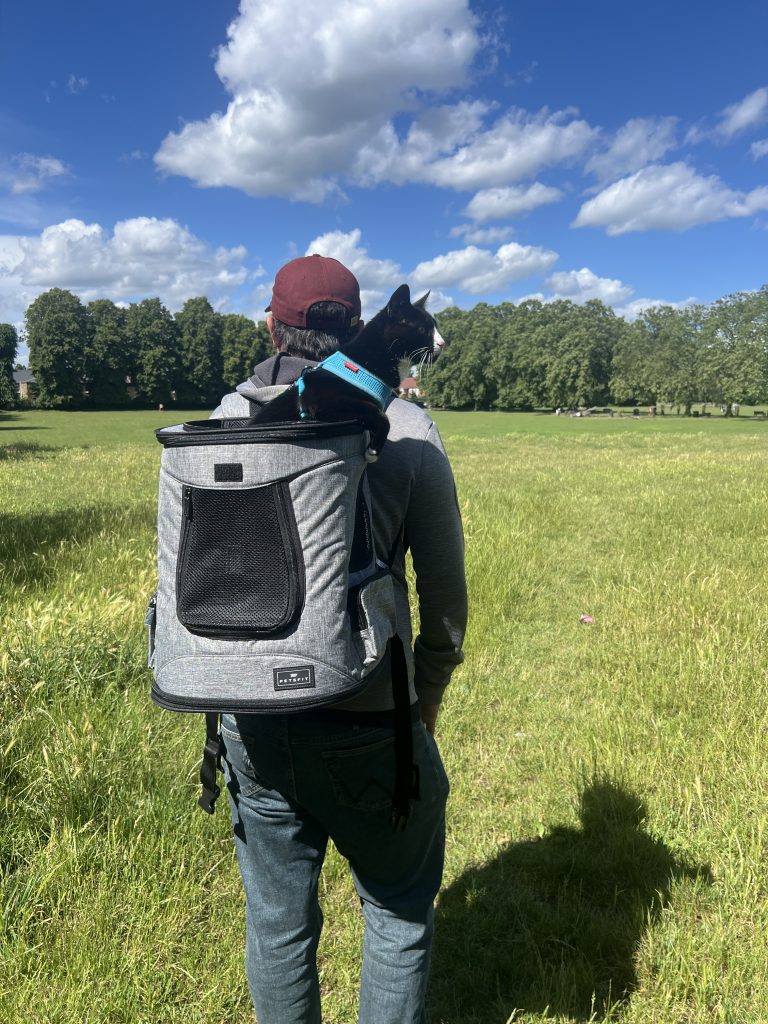
Happy cat backpacking!
Learning how to backpack train your cat takes time, patience, and a genuine willingness to let your cat set the pace. The cats who become confident, happy backpack riders are the ones whose owners never forced the issue — they built trust until the backpack became a place their cat actually wanted to be.
So start slow. Watch your cat. Celebrate small wins. The adventures will come.